

Puzzle Game Prompts
2 min read
https://combos.fun/play?release_id=93
1. Usage scenarios
When you wish to generate a:
- Does not rely on complex systems or the number of levels
- Complete the puzzle by "understanding the rules themselves"
- With a sense of humor, anti-expectation, and Meta design implications
- Small games suitable for short-term play and highly shareable
This case is very suitable as a reference. Its core lies in: making Boo understand that "the object of puzzle-solving is not the scene, but the player's mental inertia" .
2. Key points of success
- Clearly rejects traditional puzzle-solving logic: From the very beginning, it rules out conventional routines such as "using keys to open doors, number reasoning, and hidden items," and the Agent will not automatically apply established puzzle-solving templates.
- Elevate "text and UI**" to core interactive objects: ** Prompts, status text, and buttons themselves are all allowed to be sources of solutions, and the Agent will naturally generate more conceptually oriented puzzle-solving methods.
- Level objectives are clear but the solutions are counterintuitive: In each level, players immediately know "what to do" at a glance, but the actual way to complete it comes from literal understanding or misuse of rules, ensuring the "aha moment".
3. Core stable structure
When reusing this case, the following structure is recommended to be retained as a whole:
- Single-screen level without complex scene switching
- Each level has 3–6 interactive elements, the vast majority of which are distractors
- Solutions come from: text itself / UI behavior / conceptual operations
- Level clearance feedback is brief, self-deprecating, or laced with deadpan humor
- Levels progress linearly, with no level selection interface
The function of this structure is to force players to shift their attention from "finding things" to "understanding what you are looking at".
4. Replaceable and extensible directions
Without compromising the core of anti-routine, it can be safely adjusted:
- Humorous style (dry humor / silly / satire)
- Text Language (English / Other Languages)
- Level themes (doors, passwords, people, rooms, system interfaces)
- UI element styles (back button, prompt box, status bar, etc.)
What these changes will affect is theform of expression, not the essence of puzzle-solving.
5. Common issues and fixes
- The solution reverts to traditional puzzle-solving usually because the description of scene elements is too specific. It is necessary to emphasize again: clues do not come from item combinations, but from "literal understanding" or "the rules themselves".
- Players have absolutely no idea about the solution, indicating that the reversal is excessive. A subtle verbal hint can be embedded in the copy instead of adding elements.
- Slowing down the level rhythmcan reduce the number of interactive elements to ensure that players can quickly attempt, quickly fail, and quickly gain insights.
9. Example Prompt
*.Plain
Create a single-screen click-based puzzle game with a silly humor style and self-deprecating twists. Each level has a clear objective, but the actual solution should surprise players—emphasizing that “clues are always right in front of them, yet mistakenly dismissed as irrelevant.”
Overall Design Principles:
Single-screen levels with no complex scene transitions. Clean visuals with minimalist design. Solutions avoid traditional logic (e.g., key → door, password → number clues). Prioritize text, prompts, UI elements, or status descriptions as key clues. Each level contains 3–6 interactive elements, most serving as distractions, with only 1 being the actual solution. Correct solutions should elicit a “Oh, you can do it that way?” reaction. Post-completion feedback delivers mildly absurd or self-deprecating humor. Levels transition automatically without a selection screen.
Overall Art Style:
Minimalist black-and-white line art with pure monochrome palette (no grayscale). Evokes comic panels or rough sketches. Emphasizes negative space and restrained composition. UI elements appear “system-integrated” yet may conceal clues.
Language Consistency:
All in-game text is in English, concise, direct, and tinged with dry humor. Rules are never explained; no tutorials are provided. Players must independently realize “the rules are changing.”
Level Structure and Content:
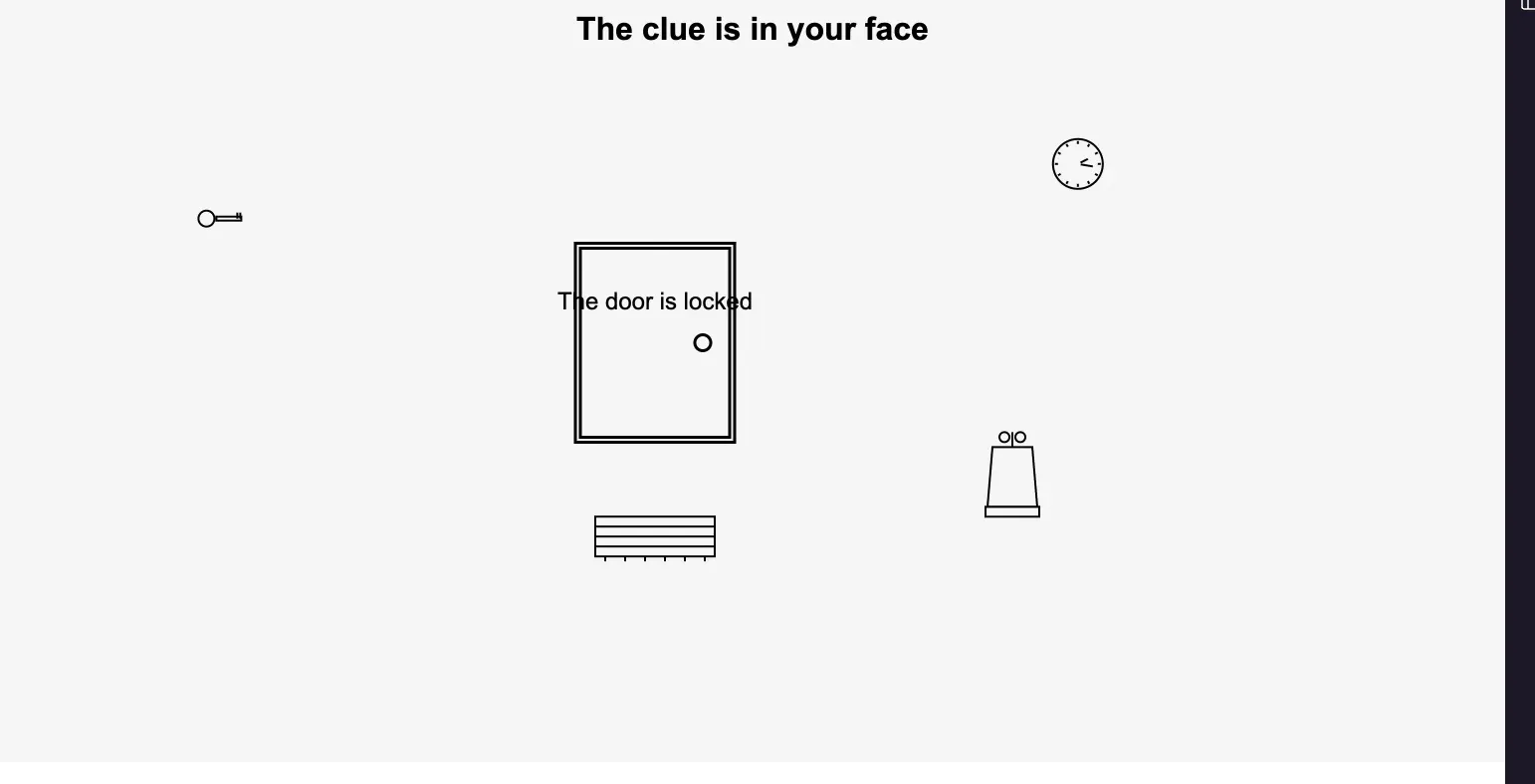
Level 1: The Door Won’t Open
Visual Content:
A door with the phrase “The door is locked.” written on it.
Obvious distractions in the scene: Key, Flower pot, Carpet, Clock
Actual solution (anti-cliché): Tap the text “The door is locked.” above the door. The text falls off, disassembles, and transforms into a key.
Additional requirement: Display the game title at the top of the screen: “The Clue Is In Your Face”
Level 2: Find the Password
(Automatically proceeds after Level 1)
Screen Content:
Password door with prompt: “The password is 4 digits.”
Scene distractions: Clock displays 12:34, Calendar shows 2025, Drawer numbered 0007
Actual Solution (text is the answer): The password isn't inferred from the scene but taken literally as “4 digits.” Player enters: 4444 → Clears level
Clear Feedback: Brief English message, e.g., “Good. You read it.”
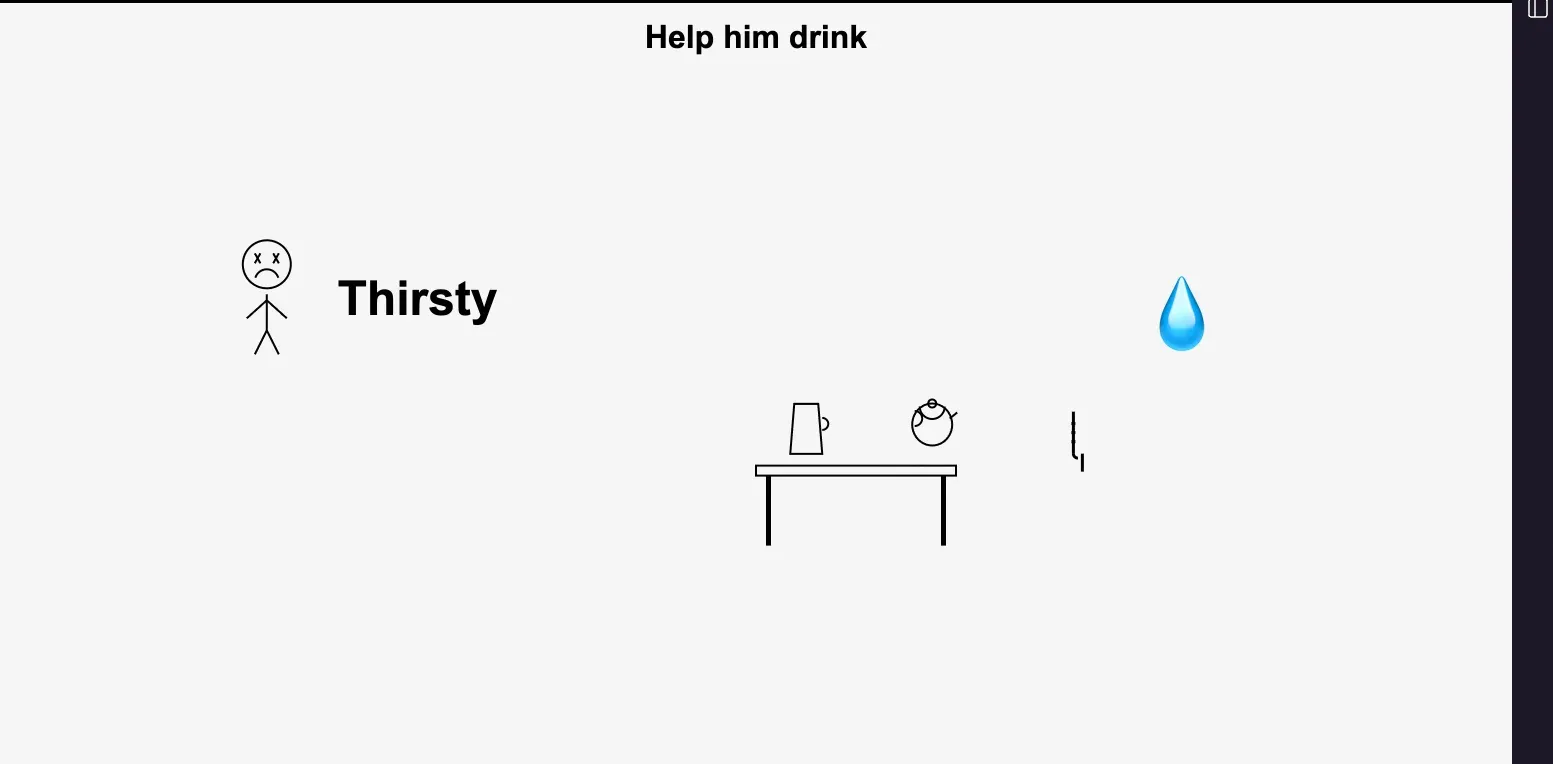
Level 3: Help Him Drink Water
(Automatically proceeds after Level 2)
Screen Content:
A thirsty person. On the table: Cup, Water jug, Straw. Text next to character's mouth: “THIRSTY”
All standard actions (pouring water, handing cup) are ineffective
Actual Solution (Conceptual Operation): Drag the “water” (as an emoji) onto the ‘THIRSTY’ text near the character's mouth. The “THIRSTY” text turns blue and disappears → Clear
Level 4: Escape the Room
(Automatically proceeds after Level 3 as the final stage)
Screen Content:
A seemingly “perfectly normal” room. All objects are clickable, e.g., Axe, Key, Phone, Table, Door. All items are distractions.
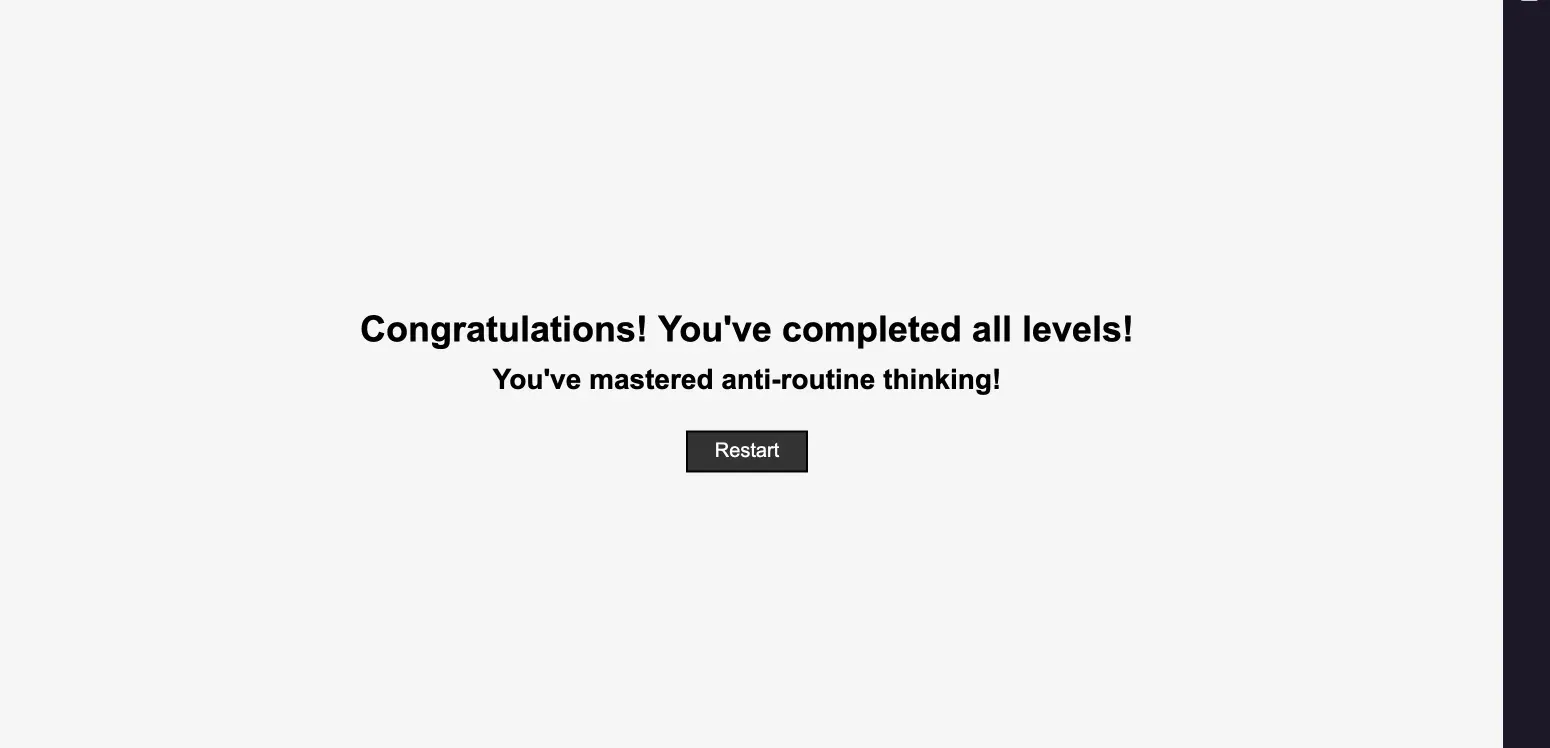
True Solution (UI = Exit): Click the “Back” button in the top-right corner (UI return key). A prompt appears: “You finally learned how to use it.”
Game Over
Overall Experience Goal:
Each level subverts players' habitual puzzle-solving instincts, gradually revealing that clues aren't “hidden” but “disguised as nonsense.” The entire game functions as a satirical commentary and reflection on puzzle games themselves.